
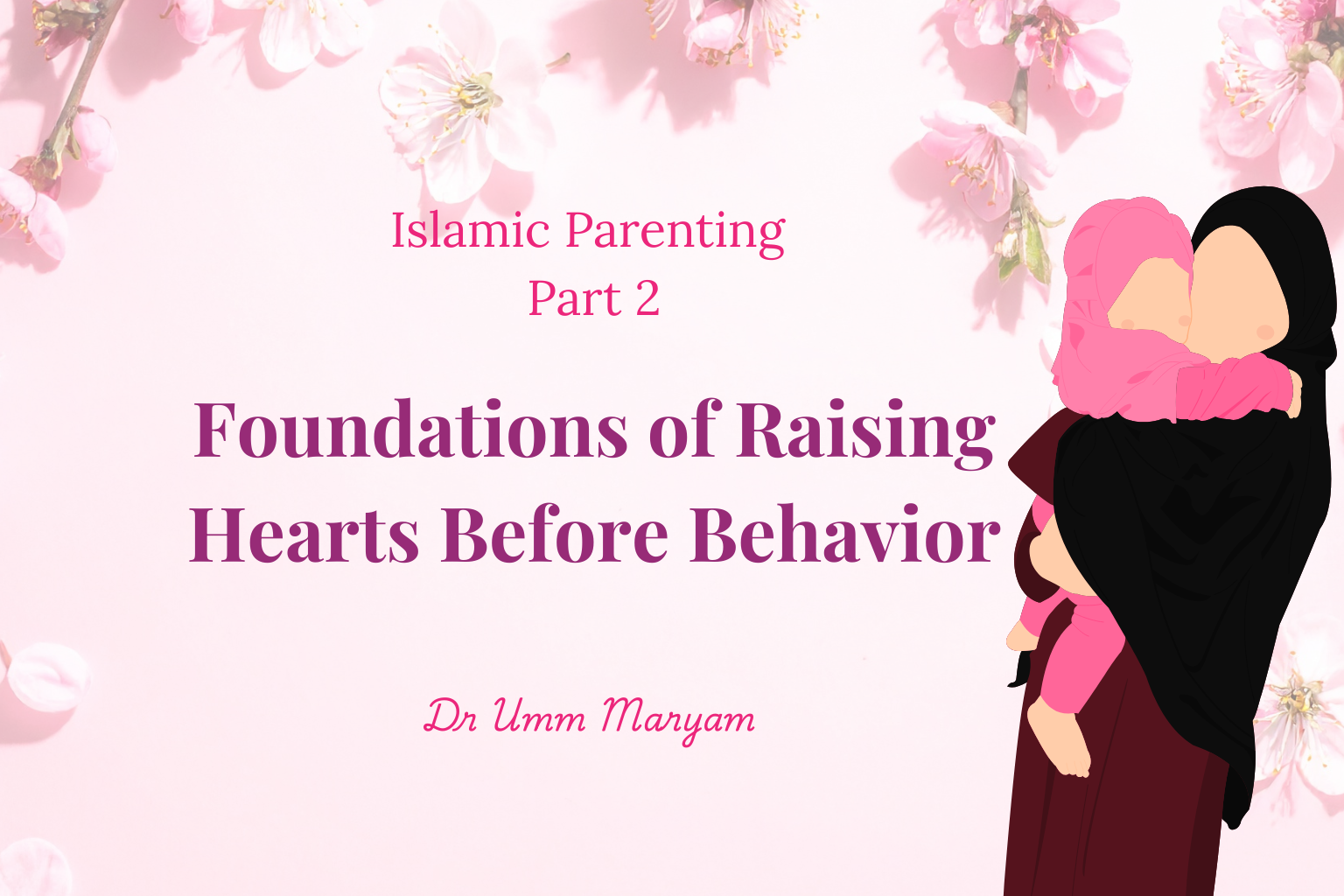
Part 2
Islāmic parenting rests upon a beautiful and profound principle: before we shape a child’s actions, we must nurture their heart. Many parenting systems focus on outward obedience, yet Islam looks deeper. It seeks to cultivate īmān, conscience, and moral awareness so that good behavior flows naturally from within rather than being forced from outside.
Allāh reminds us repeatedly in the Qur’ān that true guidance is connected to the state of the heart. When the heart is sound, actions become sound. For this reason, the earliest foundation of tarbiyah is not strict control, but connection, understanding, and spiritual nurturing.
The Heart as the Beginning of All Learning
A child who feels loved and secure is more open to guidance. When a parent prioritizes emotional safety, the child’s heart becomes fertile soil for faith and character. Harshness may produce temporary silence, but gentleness builds lasting transformation.
1The Messenger of Allah ﷺ said, “Gentleness is not found in anything except that it beautifies it, and it is not removed from anything except that it disgraces it.”
The Prophet Muhammad ﷺ taught with mercy long before he taught with rules. He listened to children, spoke to them with respect, and allowed them to feel valued.
Anas ibn Mālik, who served the Prophet ﷺ for ten years as a child, said, “He never said to me ‘uff’ and never asked why I did something or why I did not do something.”2
His method shows that adab grows where dignity is preserved.
Connection Before Correction
One of the greatest lessons from the Sunnah is that guidance must be built upon relationship. A child accepts correction when they trust the one correcting them. If discipline comes before love, it often breeds resentment. If love comes before discipline, it nurtures understanding.
When a young boy ate with improper manners, the Prophet ﷺ did not shame him. Instead he said with kindness, “O young boy, mention the name of Allah, eat with your right hand, and eat from what is nearest to you.”3
Islamic parenting therefore begins with presence. Sitting with our children, hearing their concerns, noticing their emotions, and acknowledging their efforts are not small acts. They are the doorway to meaningful tarbiyah.
Teaching Accountability With Mercy
Islam does not ignore boundaries. It teaches responsibility and accountability, yet always within the frame of compassion. Children must learn that actions have consequences, but they must also know that mistakes are opportunities for growth.
The proThe Prophet ﷺ balanced firmness with compassion. Even when guiding adults, he avoided harshness, and Allah praised his gentle approach, saying that had he been severe, people would have turned away from him4.This principle is even more essential with children whose hearts are still forming.
Modeling the Values We Seek
Children learn more from what we are than from what we say. A mother who controls her anger teaches patience without a lecture. A father who speaks truthfully teaches honesty without a lesson. When parents return to Allāh in their own weaknesses, children learn the meaning of tawbah and reliance upon their Lord.
Often Allāh reforms the parent through the child before He reforms the child through the parent.
Raising Conscience Rather Than Compliance
The aim of Islamic parenting is not to produce children who behave well only under supervision. The aim is to raise hearts that recognize Allāh even when no one is watching5. This inner compass is built slowly through love, consistent reminders, and a home where faith is lived daily.When children grow with a strong connection to Allāh, they carry their values into adulthood with sincerity rather than pressure.
A Final Reflection
Raising hearts before behavior requires patience, duʿā’, and trust in Allāh’s timing. Results may not appear immediately, but every sincere effort leaves a mark unseen to us yet known to Allah. Our task is to plant seeds of īmān with mercy and wisdom, and to believe that Allah will nurture them in the most beautiful way.
May Allāh make us parents who guide with compassion, correct with dignity, and raise children whose hearts are attached to Him. اللھم آمین
to be continued… إن شاءالله
📚 Footnotes:
- Sahih Muslim, Hadith 2594 ↩︎
- Sahih Muslim, Hadith 2309 ↩︎
- Sahih al-Bukhāri, Hadith 5376 ↩︎
- Qur’ān 3:159 ↩︎
- Qur’ān 67:12 – Praise for those who fear their Lord unseen. ↩︎
Dr Umm Maryam